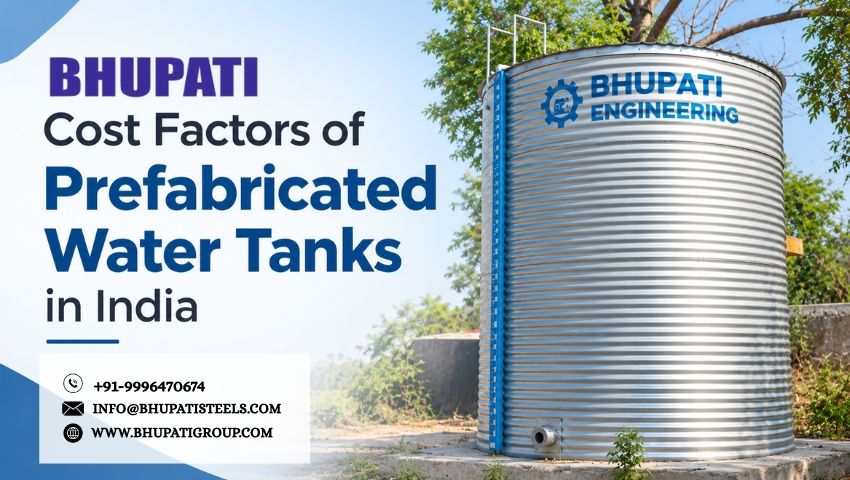
Water Storage Tanks are an essential necessity in the construction of residences, commercial buildings, industries, and governmental projects. While making choices between various options, the consumer tends to look at factors like durability, time taken for installation, maintenance, and cost of the entire project. The use of a prefabricated water storage tank presents itself as a good choice due to its various advantages.
The total cost of the prefabricated water storage tank in India is dependent on a number of technical and project-specific considerations. Knowing about these considerations through Bhupati Steels Pvt. Ltd., one can make the choice of choosing a tank which meets all the criteria of the buyer selection process. Some of the major factors are:
1. Tank Capacity and Storage Requirements:
This is one of the key determinants of the price of the tank.
● Small tanks: These are suitable for residential areas and smaller establishments.
● Medium tanks: These are suitable for commercial buildings, institutions, and industrial establishments.
● Large tanks: These are suitable for infrastructural work and water supply projects in communities.
The capacity of the tank should be based on the amount of water usage in a day and water availability.
2. Material Quality and Panel Specifications:
The type of material that are being used to construct the tank has direct implications for its cost of procurement, its life expectancy, and how much maintenance it will require. Prefabricated tanks may vary in panel materials and protective coatings according to their intended uses.
Such considerations as thickness, resistance to corrosion, and structural durability, among other things, will have an effect on cost. Where long-term water storage is required, appropriate material selection may decrease maintenance costs.
3. Design, Height, and Structural Requirements:
Water tank projects do not always demand the same engineering. The shape of the tanks, their sizes, their heights, and the locations where they will be installed can affect how complex the engineering will be and so does the costing.
The installation of the tanks might require more structural support, especially if the tanks are installed in places that experience strong winds and earthquakes. Customized designs can also cost more than standardized ones.
4. Transportation and Installation Costs:
Prefabricated tanks are moved in parts and installed on-site. Even though this method can ease transportation challenges in contrast to transporting an entire assembled tank, there is no way that logistics do not impact the total costs.
Cost factors involve:
● Access to the project site.
● Lifting equipment and professional installation crew availability.
● Site preparation and installation conditions.
● Plumbing works and other commissioning needs.
● Careful planning of the site is essential for preventing unnecessary costs.
5. Water Tank Application and Compliance:
In addition to the use of the intended application, the specifications and costs involved in each tank vary. Drinking water tanks may need to be made of suitable materials according to requirements. Industrial use and firefighting may require different specifications.
In case of government infrastructure programs like rural water programs, buyers need to take into account the specifications of the tender, quality documents, etc.
How to Choose a Cost-Effective Prefabricated Water Tank?
We should Compare quotes on the basis of:
● Capacity
● Materials
● Design
● Installation, and
● Warranties before buying
A lower price does not necessarily offer good value for money if it requires regular maintenance or higher installation costs. Bhupati Steels Pvt. Ltd. is one organization that could be considered while selecting a water storage infrastructure solution. They need to mention their capacity, site specifics, purpose of use, and technical details in this regard.
Conclusion:
The cost of prefabricated water storage tanks made in India is decided on the basis of capacity, quality of materials used, engineering specifications, transportation costs, installation, and maintenance. Analyzing all these together at Bhupati Steels Pvt. Ltd. will allow project owners to make an informed decision and choose a reliable water storage tank.
Frequently Asked Questions:
1. What makes up the price of a prefab water storage tank?
Tank capacity, material used, construction design, transportation, installation, and maintenance make up the total cost.
2. Is a prefab water tank cost-efficient?
Yes, the modular structure of such a tank may help in saving time and money during transportation and installation.
3. What kind of material should be used for a prefab water tank?
The type of material for a tank depends on the size of the tank, the quality of the water, the environment, and other conditions.
4. How to save money on prefabricated water tanks?
Select an optimal capacity, compare specs, prepare the site, and consider maintenance costs.