Industrial water storage needs more than just high capacity. Tanks must be designed to withstand hydrostatic pressure, environmental exposure, wind loads, and seismic forces, where applicable, while maintaining structural integrity and water tightness. For Zincalume tanks, this performance is supported by coated steel, engineered panel construction, modular design, and application-specific internal protection.
For industrial clients, Bhupati Steels Pvt. Ltd. focuses on the material selection and engineering requirements of the tank before evaluating capacity, price, or installation time.
What Is a Zincalume Tank?
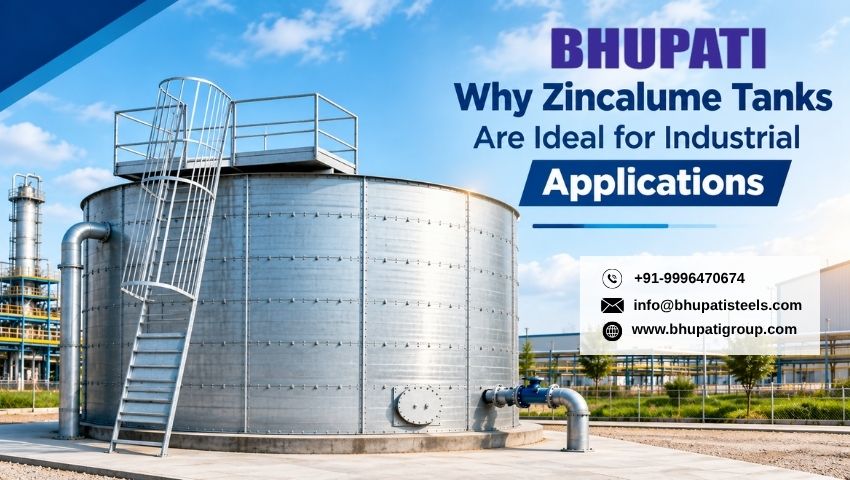
Zincalume is a metallic coating applied to steel, typically comprising about 55% Aluminum, 43.5% Zinc, and 1.5% Silicon. The aluminum-rich phase forms a barrier against corrosion, while Zinc provides sacrificial protection to the steel.
This corrosion-protection mechanism differs from that of conventional galvanized steel.
The actual coating mass/thickness should be specified according to the applicable steel specification and project environment rather than assumed from the term "Zincalume" alone.
Technical Features That Matter in Industrial Tanks:
1. Hydrostatic Load-Based Structural Design:
Water weighs approximately 1,000 kg per cubic meter. Consequently, a large-capacity tank can impose substantial hydrostatic loading on its lower shell courses and foundation.
An engineered Zincalume tank incorporates appropriately designed steel panels, stiffening arrangements, shell connections, and support components to distribute these loads. Panel thickness and structural configuration should be determined based on tank diameter, shell height, stored-water depth, operating conditions, and applicable design criteria.
For larger tanks, wind and seismic loads may also become important design considerations.
2. Corrosion-Resistant Metallic Coating:
Zinc-Aluminum coating is another important advantage of the material, Zincalume steel. Aluminum creates a comparatively stable barrier layer, while Zinc provides sacrificial protection through galvanic action if the coating is locally damaged.
However, corrosion resistance depends on atmospheric exposure, water composition, coating characteristics, cut edges, fixings, installation, and maintenance. Therefore, industrial tank selection should consider the complete material and protection system rather than the coating nomenclature alone.
3. Bolted Modular Panel Construction:
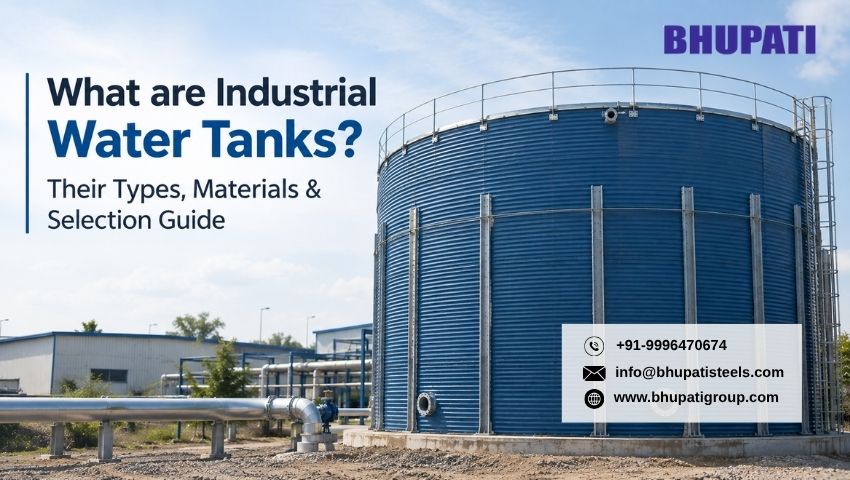
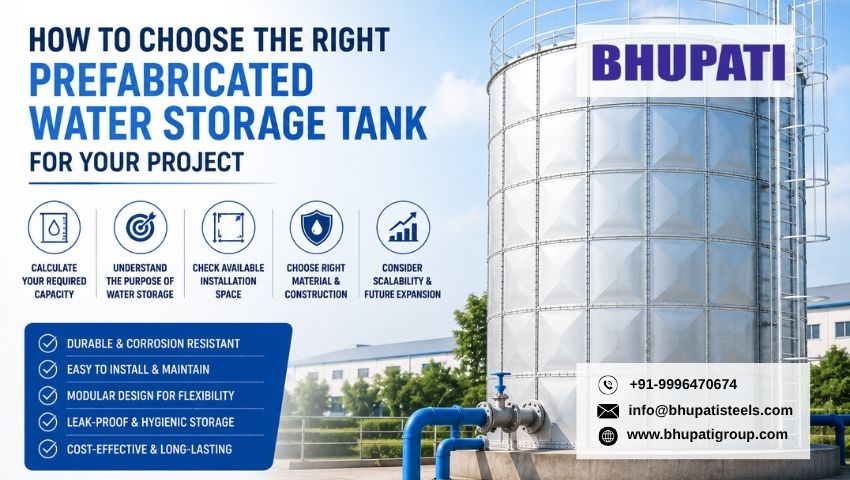
Unlike a monolithic welded tank, a modular Zincalume tank is assembled from prefabricated panels at the installation site. The accurately manufactured panels are joined together using bolted connections and sealing systems designed to maintain water tightness and leak-proofing.
This construction method provides important logistical advantages. Individual components can be transported to sites where access for large fabricated vessels is restricted and then assembled progressively at the installation location is on time.
4. Internal Lining for Application-Specific Protection:
The external Zincalume coating protects the steel from atmospheric exposure; however, the internal surface of the tank is exposed to the stored water and therefore requires application-specific protection.
Depending on the application and stored medium, the tank may require an appropriate internal liner or coating. Liner selection should consider water chemistry, temperature, intended use, and compatibility with the stored liquid.
For potable-water applications, materials in contact with water should also meet the relevant regulatory or material-safety requirements for the project.
5. Foundation Is Part of the Tank System:
A properly designed tank system extends beyond the tank shell itself. The foundation or base structure must safely transfer the load imposed by the fully loaded tank to the ground without excessive settlement or deformation.
These load, foundation, and site parameters must be considered while designing the tank base structure.
6. Designed for Inspection and Maintenance:
Industrial tanks should be planned with inspection and maintenance in mind. Access arrangements, roof configuration, fittings, overflow systems, drain connections, vents, level indicators, and internal inspection provisions should be selected according to the application.
Regular inspection of sealing components, connections, coating or lining condition, fittings, and structural elements can help identify deterioration before it affects tank performance.
Where Are Zincalume Tanks Used?
With the appropriate specification and internal protection, Zincalume tanks can be engineered for applications such as:
- Industrial process and utility water
- Fire-water storage
- Water-treatment plants
- Manufacturing facilities
- Infrastructure projects
- Agricultural and bulk-water storage
- Commercial and institutional water systems
The design should always be finalized according to the stored medium, required capacity, site conditions, environmental exposure, and applicable standards.
Why Bhupati Steel Pvt. Ltd. for Zincalume Tanks?
Choosing among Zincalume Tank Manufacturers in India requires evaluating more than tank capacity or quoted price. Steel grade, coating system, panel design, sealing system, structural calculations, foundation requirements, internal liner, fittings, installation methodology, and quality control can all affect long-term performance.
Bhupati Steels Pvt. Ltd. considers industrial water storage systems as engineered solutions in which tank design is based on project requirements. This approach helps industrial customers assess the tank’s durability, installation requirements, maintenance needs, and expected performance before selecting a water storage solution.
Conclusion:
Zincalume tanks combine a corrosion-resistant Aluminum-Zinc steel coating engineered with modular construction to provide a practical solution for large-volume industrial water storage. Their performance, however, depends on correct structural design, foundation engineering, sealing, internal protection, material specifications, and installation quality. For industrial projects, these technical factors should form the basis of tank selection—not capacity and price alone.